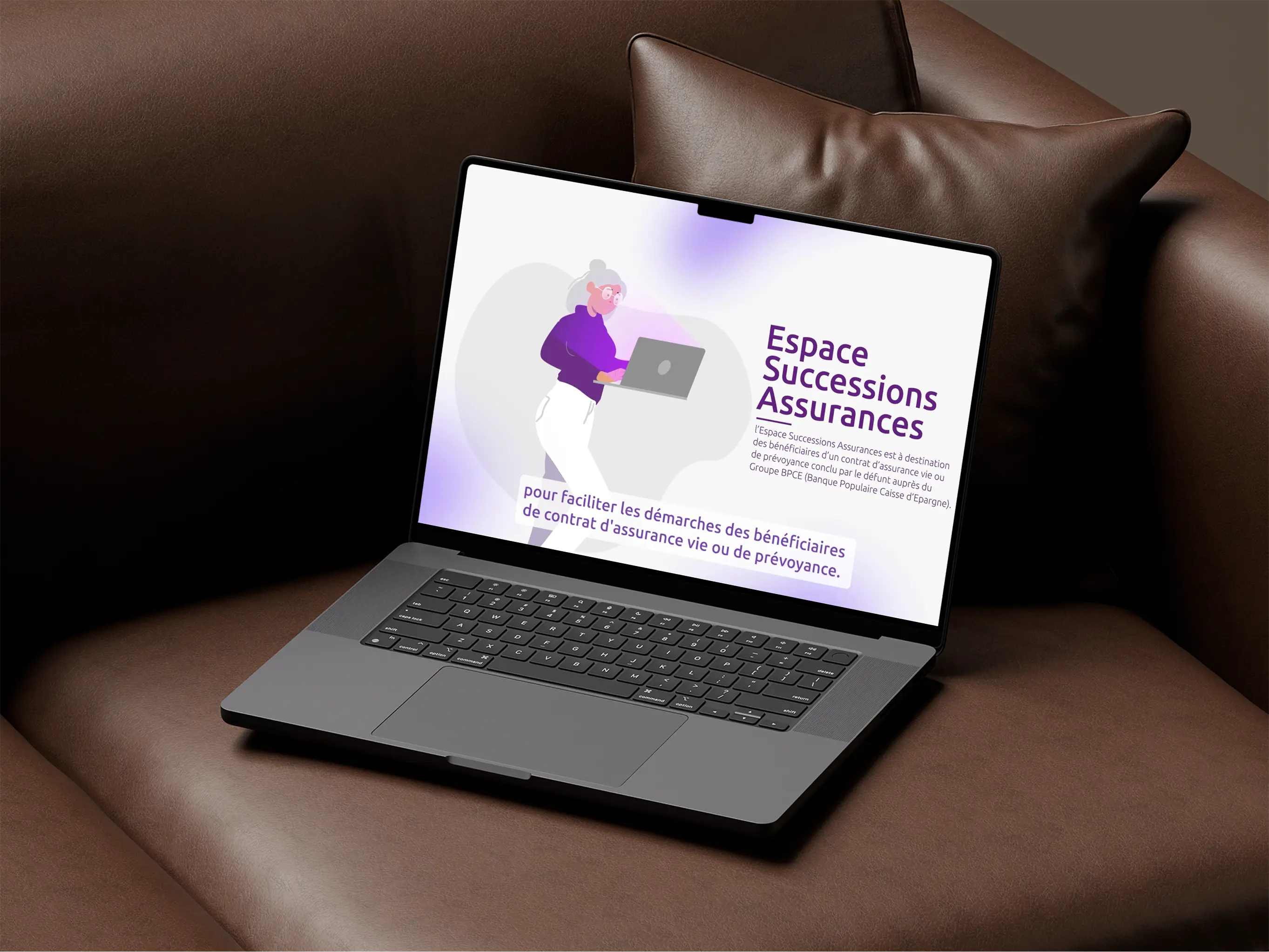
Espace Successions Assurances
Digital self-care journey facilitating administrative procedures for life insurance or personal protection beneficiaries
Context
Groupe BPCE, France's second-largest banking group with 35 million customers, needed to ensure that a key user journey was accessible in accordance with RGAA legislation. This project also has a strong human dimension: the core target audience for this journey includes people who are grieving, often aged around 70, who are unaccustomed to technology and for whom an accessible website significantly improves the user experience.
Role and responsibilities
I was the Product Designer on this project. The team included an outsourced person who was in charge of auditing the user journey, a business analyst, a developer, the Product Owner who was my manager, and myself.
I led the audit, analysed the results, identified and prioritised high-impact actions to improve accessibility. I then wrote the functional specifications for the business analyst and developer, illustrating these requirements with screenshots and annotated displays on Figma.
Approach
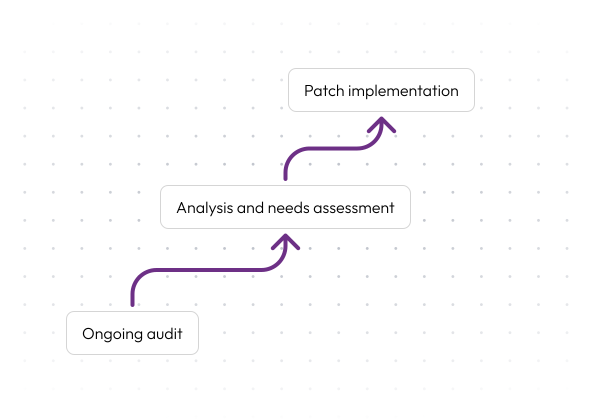
The process began with a meeting with the external firm to define the sample of pages to be audited, followed by the RGAA audit itself and the report of the results. We then analysed the points to be corrected, identified the actions that could be implemented, and prioritised those with the greatest impact.
I then prepared the requirements specification using Figma, annotating the screens and matching these elements with the HTML code. This requirements specification was presented and reviewed with the business analyst and developer.
The methods used included technical tests wit, and without, browser extensions, tests with screen readers, and close collaboration on Figma. A significant challenge was the constraint of using the Pega CMS, which sometimes limited the scope for intervention on the code and therefore full accessibility.
Solution and outputs
All modifications were focused on ensuring a more understandable experience that is accessible to assistive technologies and simpler for users. The solution consisted of thoroughly adapting existing interfaces to meet RGAA criteria. Among the main corrections:
- Re-writing link labels to make them explicit and visible, with underlining.
- Grouping and adding captions to checkboxes.
- Adding and managing ARIA attributes to improve field accessibility, including aria-describedby and autocomplete on input fields.
- Implementation of explicit buttons for deleting input.
- Correction of missing or mistranslated labels on table elements.
- Adaptations to modal components for better management of accessible interactions.

Outcomes and impacts
Before the measures were implemented, the rate of compliance with RGAA criteria was 25.8% and the average compliance rate was 43.4%. After the action plan was carried out, these rates both increased to 56.1%, marking a significant improvement in accessibility throughout the entire journey.
The action plan resulting from this project has been integrated into the product backlog and included in the annual budget to continue improvements.
On a personal level, this project has strengthened my ability to communicate effectively with developers, by understanding their technical constraints and sharing a common language, which is essential to the success of a project as complex as RGAA compliance.
The main lesson learned is that accessibility is not just about people with disabilities, but benefits everyone. Integrating it from the design stage is more effective than correcting it after the fact, where the impacts can be complex and expensive.